
Pearl City Directory Holdings
The University of Southern Mississippi's Jackson/Pearl city directory index is the strongest published lead for Pearl. It lists Pearl-area runs for 1940, 1945, 1947, 1948, 1950, 1952-53, each year from 1954 through 1969, 1971-77, and 2000. Treat those as collection years. They are not a continuous run. No volume is guaranteed to cover every Pearl address. Even so, the index works well as a starting point. It names the area and the volume years before any request goes to a library or archive.
| Collection | Years | Where Held | Access |
|---|---|---|---|
| USM Jackson/Pearl printed volumes | 1940; 1945; 1947; 1948; 1950; 1952-53; 1954-69; 1971-77; 2000 | USM Mississippiana | Online collection index; ask about the needed volume and section |
| USM Mississippiana telephone books and vertical files | Collection spans 1699-present | McCain Library and Archives | Research help for printed municipal volumes, telephone books, clippings, and pamphlets |
| Gale Jackson-area directory reels | 1937-39, 1939-40, 1941-43, 1943-47 | Publisher reel catalog | Corroborate a likely volume, then confirm library holdings |
| Rankin County Historical Society material | Dates vary by item | Brandon Public Library relationship and society collections | Surname and minutes databases; confirm current access first |
The USM city-directory index is the source behind the listed runs.
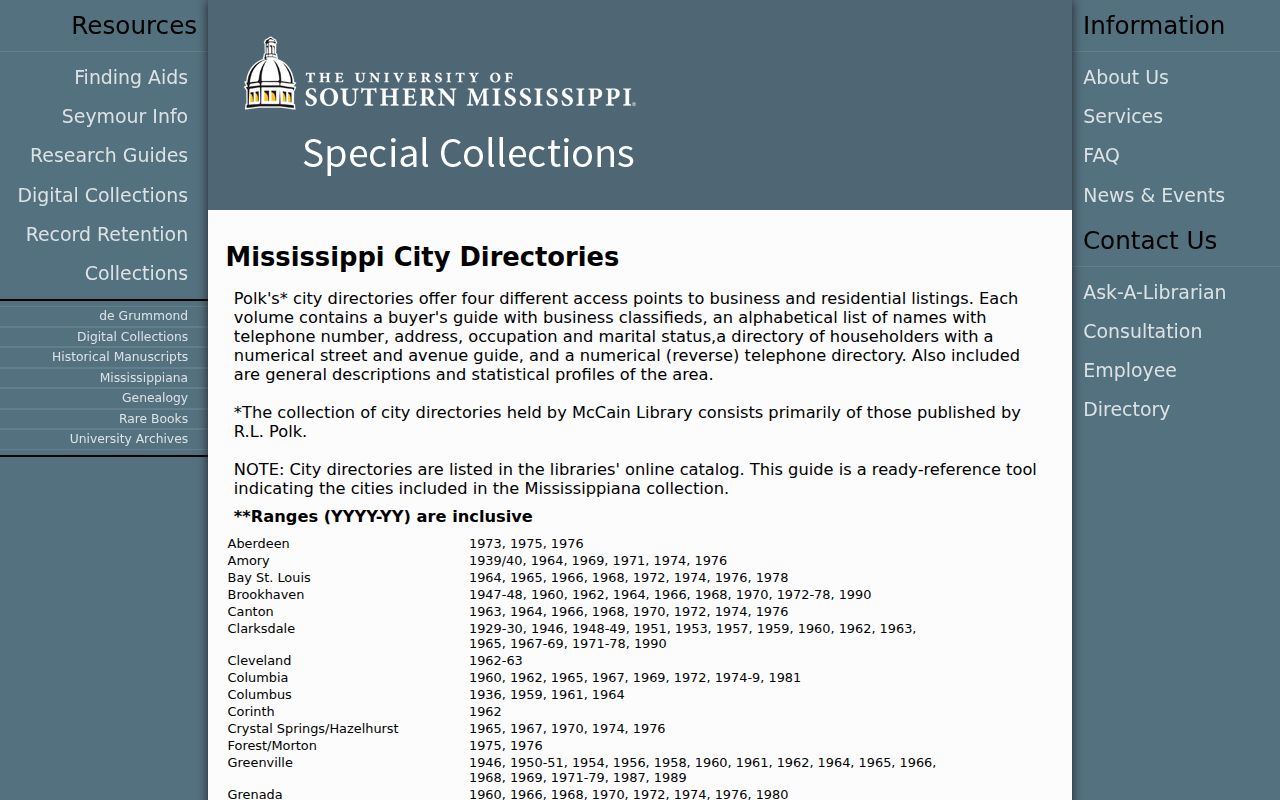
The index narrows a request to a known year. It cannot substitute for viewing the actual directory page and checking how that volume labeled the Pearl-area address.
Pearl Directory Labels Beyond City Limits
Pearl did not incorporate until 1973. Earlier residents appear in Rankin County records or under Jackson-area conventions. The Gale catalog shows the mix. Its 1937-47 reels carry Jackson, East Jackson, and Pearl City labels side by side. One city label is rarely enough. A search that quits after a single name can miss the right listing, so copy the volume's spelling, street form, rural-route wording, and telephone detail exactly as printed.
The label problem reaches later records too. A deed may cite a legal description, a subdivision, block and lot, or section, township, and range rather than a modern street name. Weigh the place label carefully. Set the directory's label against Rankin County sources, the street guide, and the parcel description. Two labels can still mean one place.
Note: A Pearl-area directory entry is a dated publishing record, not proof that the address sat inside city limits in that year.
Reading a Pearl City Directory Entry
USM describes the usual Polk-style volume section by section. There is a buyer's guide, an alphabetical section, a numerical street or avenue guide, and a reverse telephone directory. The alphabetical entry carries the details. A surname and given name come first. A telephone number, street address, occupation, and marital-status notation may follow. The same guide mentions general descriptions and statistical profiles. None of this reconstructs any named person's entry; it simply inventories the collection's format.
| Name | The printed surname and given name, which should be copied before spelling variants are tried. |
|---|---|
| Telephone number | A published number that can point to the reverse telephone section when the name is uncertain. |
| Street address | The directory's address form, useful with its numerical street or avenue guide. |
| Occupation and marital notation | Context printed in the alphabetical section, not a claim about every person in a household. |
| Buyer and classified sections | Business and service context that may help distinguish similar names. |
- Criss-cross directory
- An address-ordered directory section that starts with a street and works toward listed household or subscriber information.
- Householder index
- A portion of a volume arranged around the household or address rather than the main alphabetical name list.
- Abbreviation key
- The volume's explanation of shortened terms and symbols; copy it with an entry so later readers do not guess at its meaning.
Request Pearl Directory Volumes
USM's Mississippiana department holds city directories for major Mississippi cities, statewide telephone books, and vertical files of clippings and pamphlets. A good request is specific. Name Jackson/Pearl City, the exact volume year, and the section wanted. Add a surname, street, or telephone number. Ask for the particular alphabetical, householder, street-guide, or reverse-telephone page. A broad request for a whole family tends to stall.
Two channels stand out. The USM Mississippiana collection and its research-help service are the best documented routes for directory work. CMRLS Pearl Public Library can point local reference questions the right way, though its branch page does not list directory, obituary, or microfilm holdings. For Historical Society material, bring a surname, institution, approximate date, and community name. Confirm current hours or viewing arrangements before any visit.
Trace Pearl Households Across Directory Years
Start a household trail from one exact directory year. Build outward only when the next source agrees. USM's continuous 1954-69 run and its 1971-77 volumes make short-interval moves easy to spot. The federal census offers a wider household check. Church minutes, tax lists, and county records fill the years before the directory shelf begins. A disappearance can mean a move, a death, an unlisted telephone, or a shift in the directory's coverage.
- Locate the surname or address in one identified volume and record the year, page, section, spelling, and abbreviations.
- Check the preceding and following listed years for the same street, phone, or household form rather than relying on a name alone.
- Use the numerical street guide or reverse telephone section when the alphabetical search does not settle the address.
- Pair the time span with the relevant federal census and note whether each source identifies a householder, subscriber, or another role.
- For a dated ownership question, compare the entry with a Rankin deed or parcel record instead of assuming the listed person owned the property.
Current address research fits the Pearl Street Directory better. It handles present-day parcel and official-record lookups in ways a historical printed listing cannot.
Pearl City Records Begin in 1973
Pearl's 1973 incorporation is a dividing line, not a single municipal resident file. City hall keeps records by department. After incorporation, council, planning, municipal court, police, permit, utility, election, and code records sit with whichever City department owns them. The City Clerk routes targeted requests that way. No unified municipal name index or historical city-directory database exists at the city level. Before that line, Rankin County, church, state, federal, and predecessor-community sources carry the trail.
Pre-city addresses point elsewhere. MDAH identifies Rankin government holdings from 1819 through 1940. FamilySearch catalogs Rankin deed books from 1801-1901, general indexes through 1920, and township plats for 1821-1935. These records often outlast the name. They can preserve the land or institution behind an address when the modern Pearl label is absent.
Rankin Records Fill Pearl Directory Gaps
Rankin County record groups help when a directory year is missing. Mississippi State University lists Rankin histories, an 1840 census index, an 1841 state census, tax lists for 1828, 1835, and 1847, and several church-minute series. MDAH adds affidavits, board minutes, juror and witness certificates, justice court dockets, land indentures and deeds, Pearl River Academy records, and assessor personal-net-worth records. None of these matches the printed volumes in scope. Still, a family can often be placed in a county, church, tax list, or land record during a gap between directory years.
Work through the MSU Rankin genealogy collection and the MDAH Rankin guide by named series and date span. Ask for a known church-minute run or a single tax year. That request serves a residents directory search far better than a plea for every mention of a surname.
Pearl Records After the Courthouse Fire
The 1924 Brandon courthouse fire is a real survival problem for any Pearl research trail. MDAH's architectural history records that the 1853 courthouse burned. It also notes that the present courthouse occupies the same site. So a blank search in a historic index proves nothing. It says nothing about whether an address, deed, or family record once existed. Report a negative result as not located in the surviving or indexed series. Then turn to MDAH material, FamilySearch catalogs, tax records, church minutes, or later reconstructed indexes.
The Rankin County Historical Society offers another local route. It reports more than 5,000 historical documents. It also keeps surname and minutes databases through its library relationship. Its blog is dated, so confirm access before travel. Do not assume every item is digitized or searchable online.
Limits of a Pearl City Directory
A city directory records only what its publisher chose to print at a given moment. An entry may reflect a telephone subscriber or a householder. It may mark a business, or follow some other directory definition. Either way, it is not a census of every person at an address. The 2000 USM volume is a late historical anchor, not proof of a present-day household. And a printed address establishes no title. It sets no city limits. It implies no lasting tie to the place.
Pearl Directory Research Roles
Careful historical work names the relationship each source actually shows. A residents directory entry marks a subscriber or householder. A deed identifies parties to a recorded instrument. A parcel record is a tax and property snapshot. Church minutes can show membership, a death, a dismissal, or a community tie. Matching dates and addresses across these records makes a strong lead. But keep each source's role visible in your notes.
Pearl's short city history and deeper Rankin roots make that discipline essential. When the first Pearl search fails, pair the surname with the route. Try the church, a Jackson-area label, a parcel, or the county. The payoff is a cleaner family-history record. Fewer false conclusions come from a single printed line in one city directory.
Note: Save the source URL, volume year, page, and access date with each transcription so the work can be checked later.